
Michigan is home to some of the most beautiful landscapes in the country, defined by dense forests, vibrant suburban canopies, and stunning backyard trees. However, keeping our local trees healthy requires constant vigilance. Just like humans, trees are susceptible to infections that can weaken them, ruin their aesthetic appeal, and in severe cases, cause total tree failure.
As a homeowner or property manager, catching the early warning signs of infection can mean the difference between saving a historic tree and having to remove it.
At County Tree LLC, we believe education is the first line of defense. Here is a guide to the most common and destructive tree diseases currently affecting Michigan trees, and exactly how you can spot them.
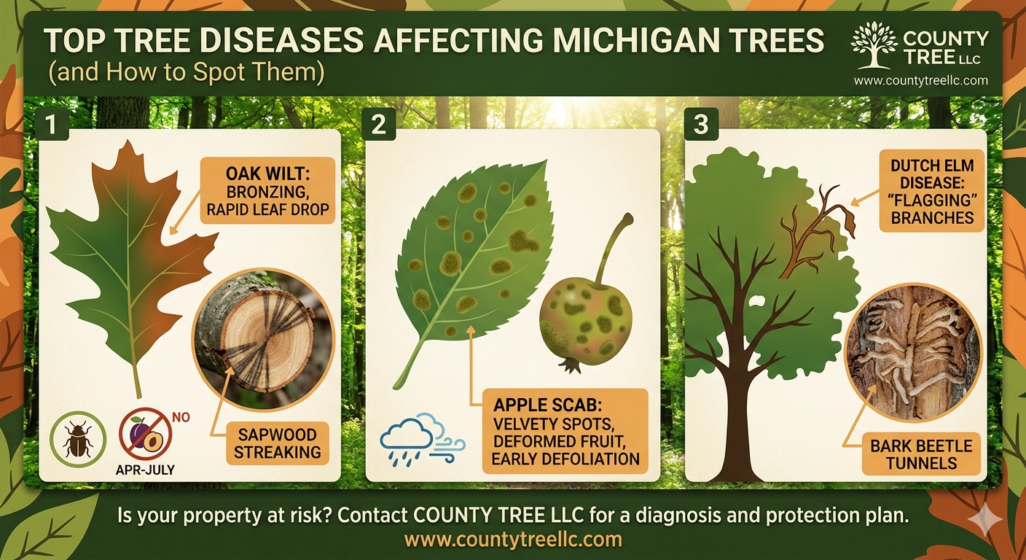
1. Oak Wilt (Bretziella fagacearum)
Oak wilt is one of the most aggressive and deadly tree diseases in Michigan. It is caused by a fungus that invades the water-conducting vessels of oak trees, essentially starving them of hydration. While it can infect all oaks, trees in the red oak family (like Northern Red Oak and Black Oak) can die within just a few weeks of infection.
How to Spot It:
-
Rapid Leaf Drop: Sudden, dramatic leaf loss in the middle of summer (typically July and August).
-
Distinct Discoloration: Leaves will begin turning a dull green or bronze color, starting at the outer edges and tips and moving inward toward the stem.
-
Fungal Mats: You may notice vertical cracks in the bark. Underneath these cracks, the fungus creates “mats” that emit a sweet, fruity odor that attracts sap-feeding beetles.
Pro-Tip: To prevent oak wilt, never prune your oak trees between April and July, as the beetles that spread the disease are highly active during this time and are attracted to fresh pruning cuts.
2. Apple Scab (Venturia inaequalis)
If you have crabapple trees or standard apple trees on your Michigan property, you have likely run into Apple Scab. This is a fungal disease that thrives in the cool, wet springs typical of the Great Lakes region. While it rarely kills a tree outright, consecutive years of severe infection can drastically weaken the tree, making it vulnerable to pests and harsh winter weather.
How to Spot It:
-
Velvety Spots: In late spring, look for olive-green to brown, velvety spots on the leaves. As the disease progresses, these spots turn black and woody.
-
Yellowing Leaves: Infected leaves will eventually turn completely yellow and drop prematurely, often leaving the tree looking bare by mid-summer.
-
Deformed Fruit: If the tree produces fruit, the apples or crabapples will develop sunken, brown, corky spots, often cracking open.
3. Dutch Elm Disease (Ophiostoma novo-ulmi)
Dutch Elm Disease (DED) is a legendary killer that decimated millions of American Elms across the United States in the 20th century, and it remains a massive threat in Michigan today. Spread by bark beetles or through interconnected root systems, DED blocks the tree’s vascular system, preventing water and nutrients from reaching the canopy.
How to Spot It:
-
“Flagging”: This is the classic first symptom. A single branch or a small cluster of branches high in the canopy will suddenly wilt, turn yellow, and droop while the rest of the tree looks healthy.
-
Brown Vascular Streaking: If you peel back the bark on a dying, flagged branch, you will see distinct dark brown or plum-colored streaks in the sapwood underneath, rather than clean, cream-colored wood.
Other Notable Michigan Tree Threats
While Oak Wilt, Apple Scab, and Dutch Elm Disease are incredibly common, Michigan trees also face threats from:
-
Beech Leaf Disease (BLD): A relatively new threat causing dark bands between leaf veins on beech trees.
-
Needle Cast: A fungal infection causing spruce tree needles to turn brown/purple and drop from the inner branches outward.
What to Do If You Suspect Your Tree is Sick
Tree diseases spread quickly—not just throughout a single tree, but to neighboring trees on your property and throughout your community. Early diagnosis is absolutely crucial.
If you notice yellowing leaves out of season, strange spots, or dying branches in your canopy, don’t wait for the problem to take over.
Why Choose County Tree LLC?
At County Tree LLC, we specialize in diagnosing and managing local Michigan tree diseases. Our experienced team can assess the health of your canopy, provide targeted treatments (such as fungicide injections or strategic pruning), or safely remove infected trees to protect the rest of your landscape.
Protect your property’s value and beauty. Contact County Tree LLC today at [Your Phone Number] or visit us at www.countytreellc.com to schedule a professional tree health consultation!